Three-Piece Filleting (Sanmai Oroshi): The Foundation
The three-piece fillet is the fundamental butchering technique for sushi and sashimi. A whole fish is broken into two fillets (one from each side) and a backbone (which becomes trim or dashi stock). Begin with a sharp deba or butcher's knife and a whole fish that's been gutted and scaled. Position the fish on your cutting board with the head pointing away. Make a vertical cut behind the gills and pectoral fins down to the backbone. This cut should be precisely perpendicular to the spine. Now, starting from this vertical cut, use a long, smooth slicing motion along the spine. Keep the knife blade in light contact with the ribs as you slice toward the tail. The knife should glide smoothly, removing the fillet cleanly from the bones. By the time you reach the tail, you should have removed one complete side. Flip the fish and repeat on the other side. You now have two fillets and the backbone with ribcage. This sanmai oroshi is the most common butchering method globally.
Five-Piece Filleting (Gomai Oroshi): The Advanced Technique
The five-piece fillet, or gomai oroshi, is the standard technique for flatfish such as hirame (fluke) and karei (flounder). Instead of taking one fillet per side, you split each side along the lateral line into a dorsal fillet and a ventral (belly-side) fillet, yielding four fillets plus the skeleton—five pieces. Because a flatfish's flesh spans two broad, thin sides rather than two deep flanks, this lateral-line split is the cleanest way to remove the meat without tearing it. Run your knife along the lateral line down to the spine, then work outward over the fin rays to free each quarter fillet. The engawa (fin muscle) along the edges is a prized sushi topping and should be trimmed and reserved separately. Note that the oo-toro (fatty belly), chu-toro (medium fatty), and akami (lean) distinctions of high-end sushi come from breaking down massive tuna loins—a separate process entirely, not gomai oroshi.
Removing the Bloodline and Parasite Prevention
The bloodline runs along the spine and can carry a stronger flavor than the surrounding flesh. The current fish recipes describe trimming it when needed, while keeping the fish chilled. Pin-bone and visual inspections support preparation, but removing a visible worm or trimming a suspect patch does not establish safety for raw consumption. Documented sourcing and appropriate parasite controls remain separate requirements. See the sourcing lesson before preparing raw fish.
Portioning for Nigiri and Sashimi
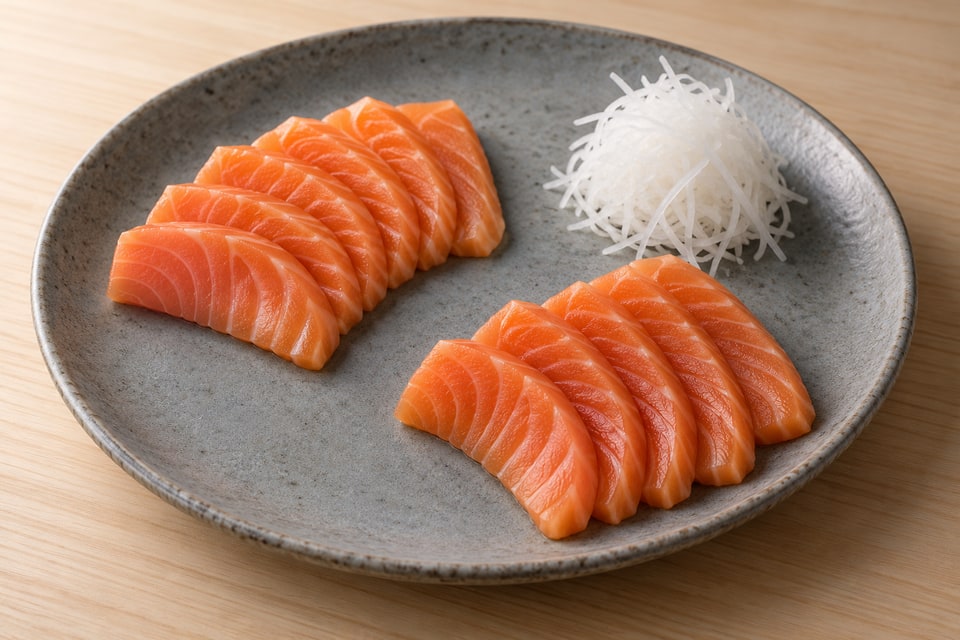
Once you have a clean fillet with the bloodline removed, you must portion it appropriately for your intended use. For nigiri, slice against the grain at a slight angle (approximately 30 degrees) to create pieces approximately 2 by 1.5 by 1/8 inch. Each piece should be individually beautiful—no torn or ragged edges. For sashimi, you might cut thicker slices (1/4 inch) and use a pull-cut motion to create clean, beautiful presentation slices. Some cuts require thin slices from the middle of the fillet (most tender), while others use the edges and tail (slightly chewier texture). You should mentally map your fillet: this section is perfect for thick sashimi, this section for nigiri, this section for tartare or tartar. Different parts of the fillet have different textures and marbling, and a skilled butcher allocates each part to the preparation that showcases it best.
Yield Expectations and Waste Optimization
A whole fish doesn't yield as much usable flesh as you might expect. A typical 3-pound whole fish (gutted and scaled) yields approximately 50-55% usable fillet (1.5 to 1.6 pounds). The remaining weight is bones, head, skin, and trim. Understanding yield prevents sticker shock at the fish counter and helps with pricing. The head, bones, and trimmings aren't waste—they become dashi (Japanese stock) or fish fumet. Some sushi establishments serve grilled fish head as a delicacy. The skin can be crisped and served. The more you minimize what you discard, the better your cost management and your relationship with ingredients. Professional chefs develop extensive knowledge about which parts of which fish are best for which purposes. A toro-heavy fish like fatty tuna has higher value than a lean fish like tai. A fish from a certain season will have different characteristics than the same fish species in another season.
Understanding Bone Structure and Fillet Accuracy
Mastering fish butchery requires understanding the skeleton. The spine runs the entire length, with ribs attached on both sides. Some ribs are softer and more pliable; others are harder. The backbone itself has tiny pin bones that extend into the flesh. These pin bones are usually removed post-fillet using tweezers or a pin bone remover. Larger pin bones should be felt with your fingers and removed; smaller ones might remain if they're not easily accessible. The tail has a pattern of bones called the tail vertebrae. Understanding this structure helps you identify where you are in the filleting process and ensure you're following the skeleton correctly. A fillet that's been removed correctly shows the impression of the spine and ribs on its inside surface. If you're removing too much flesh or cutting into the backbone, you've drifted from the ideal path.
Species-Specific Techniques and Variations
Different fish species require slightly different butchering techniques due to bone structure and flesh characteristics. Flat fish like fluke or halibut are filleted differently than round fish because they have bilateral symmetry rather than left and right sides. Some fish (like large tuna) are so large that butchering is done on special tables with specialized equipment. Smaller fish might be left whole and served head-on. Understanding species-specific characteristics is part of advanced fish knowledge. Salmon, with its characteristic silvery skin and pink flesh, fillets differently than white fish. Fatty fish like mackerel or eel require different handling to preserve the skin integrity. A sushi chef's education includes extensive training in species-specific butchering.
Keep these details in mind.
- Sanmai oroshi (three-piece) breaks fish into two fillets and backbone; gomai oroshi (five-piece) is the flatfish breakdown, splitting each side along the lateral line into dorsal and ventral fillets
- Remove the bloodline by carving V-shaped cuts along its entire length to eliminate metallic flavor
- A whole 3-pound fish yields approximately 50-55% usable fillet; bones and trim become stock and other preparations
- Portion fillets based on texture and position: middle for delicate nigiri, edges for chewier sashimi, tail for tartare
- Understand bone structure (spine, ribs, pin bones) to fillet accurately and consistently
From reading to cooking.
Salmon Sashimi Platter · Perfect Sushi Rice
Return to the journal ↗