The dish
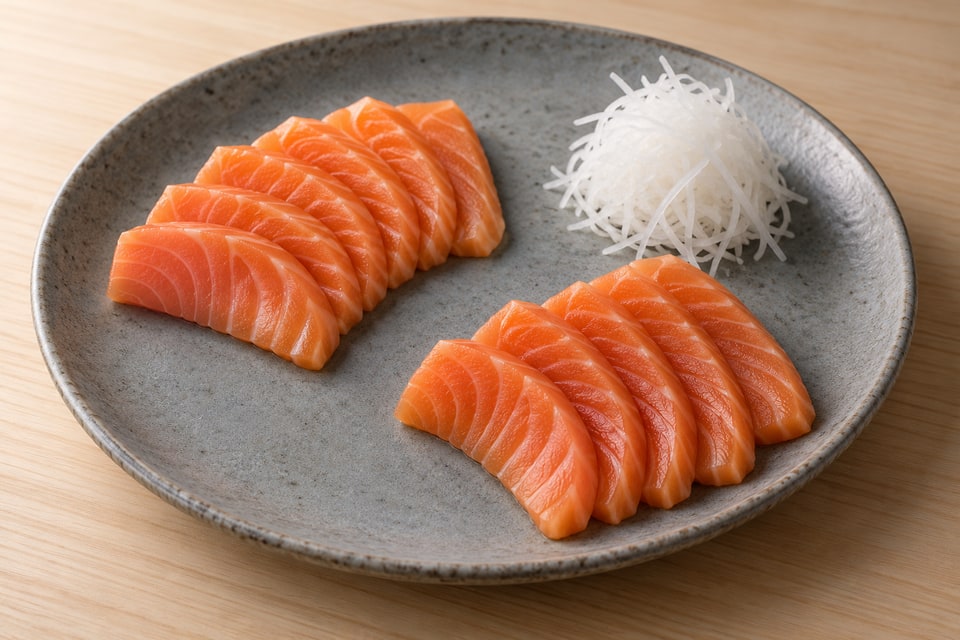
Salmon sashimi is an exercise in cutting and service rather than cooking. The block should be properly sourced for raw consumption, kept cold, and sliced across its muscle grain with a clean pull of the blade. A broad, smooth face gives a softer bite than a ragged edge. The daikon alongside has another purpose: its crisp, mild texture refreshes the palate between rich slices.
This platter uses one reliable cut rather than attempting several formal cutting styles with a small piece of fish. It is a home service for two, with soy sauce and wasabi kept separate so the salmon remains plainly tasted. A sharp chef’s knife is sufficient when a specialist sashimi knife is unavailable. Set the plate, garnishes, and table first. The short interval between slicing and eating is part of the result, and dependable cold handling is part of the recipe.
At a glance
| Item | Plan |
|---|---|
| Active work | 25–30 minutes |
| Hands-off work | None, apart from keeping the fish chilled |
| Difficulty | Moderate; sharp knife and stable board required |
| Key techniques | Pin-bone inspection, cutting across the grain, draining garnish |
| Make-ahead verdict | Wash garnishes ahead; slice the fish at service |
| Yield | Two light portions |
A closer look at the ingredients
Quantities live in the recipe card.
The salmon
properly handled fish is the center of the plate.
The crisp garnish
drained daikon provides texture without watering the fish.
At the table
measured accompaniments keep the salmon distinct.
Before you begin
The craft, step by step
The complete method.
Read through once before you begin. The working recipe follows below.
Doneness & Quality Checkpoints
- There is no cooked-doneness test for this platter. Supplier controls and continuous cold handling are the relevant safety checks.
- Fish surface: cohesive, smooth slices without pin bones or ragged muscle fibers.
- Slice texture: soft enough for a comfortable bite, thick enough to lift without tearing.
- Garnish: crisp daikon that has been thoroughly drained; no puddle at the base of the platter.
- Temperature: fish remains cool at service; it has not been left out to “develop flavor.”
- Balance: salmon first, a measured salty accent second, wasabi used sparingly, ginger between pieces.
Finish & Plate
Use a plain, cool plate with open space between the two groups of salmon. A restrained daikon nest provides height without hiding the cut faces. Give each diner an individual soy dish and a small wasabi portion so the whole platter stays clean. Avoid pouring sauce over the salmon in advance; it stains the surface, changes the balance, and makes later bites less distinct. For a larger menu, make sashimi the first brief course, then serve cooked vegetables, soup, or freshly formed sushi. Prepare each course in a small sequence so raw fish remains refrigerated until its turn.
The working recipe
Salmon Sashimi Platter
Prep: 25–30 minutes · Cook: None · Total: 25–30 minutes · 2
Ingredients
The salmon
The crisp garnish
At the table
Instructions
- Check the fish and its sourcing information over 2–3 minutes. Confirm that it was supplied for raw consumption and that applicable parasite controls are documented. Open the package on the fish board, remove any remaining bones with tweezers, and trim ragged edges. Safety — Raw fish retains microbial risks even after correct parasite freezing. Pregnant, older, immunocompromised, and very young diners should choose cooked fish. Do not judge safety from color or smell alone. Checkpoint — The flesh is cohesive and cleanly handled, with no hard bones, excessive slime, or unpleasant odor. Reject damaged or doubtful fish rather than trying to wash away a problem.
- Cut the daikon into fine threads over 4–6 minutes, using a mandoline’s guarded fine attachment or a sharp knife. Make thin slices, stack a few at a time, and cut across them into threads. Keep your fingertips tucked behind the blade; short, steady stacks give better control than a tall pile. Checkpoint — The threads bend without collapsing and remain crisp at the bite. Coarser knife-cut matchsticks are a useful home alternative; they need not be disguised as specialist knife work.
- Rinse the daikon in the measured cold water for 30–60 seconds, then drain for 3–5 minutes. Spread it on a clean towel and blot gently. This removes loose moisture and prevents the garnish from making a puddle under the fish. Wash and dry the optional shiso and cucumber separately. Checkpoint — A small handful leaves no dripping water when lifted. The garnish smells fresh and mild; the threads retain a crisp surface.
- Identify the salmon’s muscle grain over 30–60 seconds. Position the block so the cut crosses the visible fiber lines. The exact diagonal angle depends on the block’s width and depth. Work with the piece you bought rather than forcing a narrow block into an oversized slice.
- Slice the salmon in 3–5 minutes. Place the heel of the knife at the far edge of the intended cut and draw smoothly toward you, using the blade’s length. Make approximately 12–16 pieces, generally 5–8 mm (about ¼ inch) thick, with the final thickness governed by a comfortable bite and the fish’s texture. Checkpoint — Each face is smooth, without deep ridges or torn edges. The slice can be lifted with chopsticks without shredding.
- Arrange the garnish and slices in 2–3 minutes. Make a small, loose nest of drained daikon at one side of the plate. Fan the salmon in two shallow groups with the smooth cut surfaces exposed. Set optional shiso beside the fish and cucumber in its own small cluster; do not place a wet vegetable layer beneath every slice.
- Divide the wasabi and soy sauce between the side dishes in 30–60 seconds. Taste one slice with a restrained touch of soy sauce, then adjust the amount used for subsequent bites. Ginger belongs between bites rather than stacked onto the salmon. Its palate-cleansing role does not make raw fish safer.
- Serve within 2–3 minutes of finishing the platter, keeping any unused fish covered in the refrigerator. If guests are delayed, return the completed platter to refrigeration immediately and serve it as soon as possible. A chilled platter helps with a brief service interval; it does not replace refrigeration for extended holding.
Troubleshooting
| Symptom | Cause | Fix |
|---|---|---|
| Ragged slices | Dull blade or repeated sawing | Sharpen the knife and use one continuous draw |
| Tough bite | Cutting along the muscle fibers | Turn the block and cut across the visible grain |
| Watery platter | Daikon or fish surface insufficiently drained | Blot the garnishes and fish gently before arranging |
| Fish slips while cutting | Unstable board or wet surface | Secure the board with a damp towel and blot the block |
| Overwhelming wasabi | Too much placed directly on the fish | Keep wasabi separate and reduce the next bite |
| Sourcing information unavailable | Product not reliably documented for raw service | Use a fully cooked preparation instead |
Storage, Make-Ahead & Variations
Serve raw salmon bought and handled for this meal on the same day. Follow the supplier’s shorter opening or thawing instructions. Keep it at 4 °C (40 °F) or colder before cutting and return unused fish promptly to the refrigerator. Do not save partially eaten raw-fish slices for tomorrow. Limit cumulative time out of refrigeration to two hours, or one hour if the surroundings exceed 32 °C (90 °F). The limit includes preparation and table service. Discard fish that exceeds it; refrigeration afterward does not undo the exposure. Use separate clean tools for cooked food and garnish. Prepare the daikon up to several hours ahead and refrigerate it, drained, in a covered container. Drain and blot it again before plating if moisture has gathered. Cut the salmon close to service. Double the recipe by making two platters in sequence, with the second portion kept cold, rather than laying all the fish on the board. For a cooked variation, cook a salmon portion for roughly 8–12 minutes in a 180 °C (350 °F) oven, allowing for thickness, until the center is opaque and flakes gently, confirmed at 63 °C (145 °F). Cool promptly for a chilled platter or serve warm on a separate plate. Identify this as cooked salmon, since its texture and preparation differ from sashimi. Live starting point: https://sashimee.net/recipes/salmon-sashimi-platter. The rewrite removes unsupported claims about fish color, exact service deadlines, and antimicrobial accompaniments.