The dish
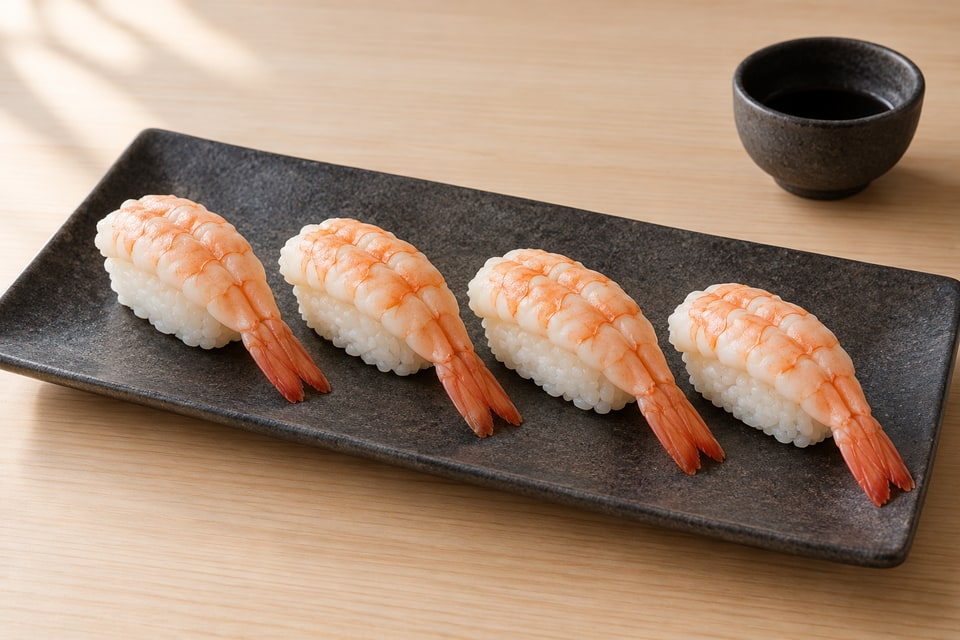
Cooked shrimp nigiri is a useful lesson in shaping because the topping is firm enough to handle and every part can be fully cooked. The goal is a straightened shrimp that opens like a book, exposing a broad belly surface for contact with the rice. Timing depends on shrimp size. Watch for an opaque, pearly center rather than treating one exact minute count as a promise.
Nigiri is a small construction with a narrow margin for excess. The topping should drape; the rice should support it without becoming a compressed pellet. This home version uses a scale for the first pieces and an ordinary sharp knife in place of a counter’s long specialist blade. Its standard is the same: clean cuts, restrained seasoning, and rice that releases at the first bite. Prepare the table before the final shaping. These pieces are best served in a small sequence, while the topping is cool and the rice still gently warm.
At a glance
| Item | Plan |
|---|---|
| Active work | About 25–35 minutes, with rice prepared first |
| Hands-off work | Rice hydration and covered rest; see the anchor recipe |
| Key techniques | straight poaching and belly butterflying; light rice shaping; immediate service |
| Make-ahead verdict | Prepare accompaniments ahead; shape to order |
| Yield | Eight pieces, four per person as a light course |
A closer look at the ingredients
Quantities live in the recipe card.
The topping
gently poached shrimp gives a firm but tender topping.
The rice and hand water
supple grains and damp fingers allow a light, coherent shape.
At the table
separate accompaniments let each bite retain its own balance.
Before you begin
The craft, step by step
The complete method.
Read through once before you begin. The working recipe follows below.
Doneness & Quality Checkpoints
- Topping: The shrimp is opaque at its thickest point and opens into two connected halves without a glassy center.
- Cutting: a smooth face with no torn edges or repeated saw marks; slice across visible muscle fibers when relevant.
- Rice: each 20 g (about 1 tablespoon) base holds with light pressure and separates easily at the bite. A dense, rubbery center means excessive handling.
- Balance: the topping leads, the rice contributes mild acidity, and wasabi stays a quiet accent. Soy sauce should support that balance rather than soak the base.
- Service: The shrimp lies flat and feels tender when bitten, with no raw translucent seam. Keep seafood cold until the brief assembly period; the warm-rice contrast is a service choice, not a holding method.
Finish & Plate
Arrange four pieces on each small plate with a finger’s width between them, so they can be picked up without disturbing the next piece. Use a plain plate that shows the cut surface and the rice’s outline. Put ginger alongside, not on top. Point the tails toward the same end of the plate and check for any remaining skewer fragment. Offer the next batch when the first has been eaten. A calm pace comes from keeping the cold ingredients covered and ready, rather than forming the whole meal in advance. For a larger supper, accompany the pieces with a simple cooked vegetable or soup.
The working recipe
Cooked Shrimp Nigiri
Prep: 25–35 minutes, plus rice preparation · Cook: 3–5 minutes poaching · Total: About 1 hour 35 minutes including fresh rice · 2 (8 nigiri)
Ingredients
The topping
The rice and hand water
At the table
Instructions
- Set the cold ingredients and rice in order, taking 3–5 minutes. Safety — Separate raw shrimp from cooked ingredients and use a clean plate after poaching. Cook the center opaque and pearly, confirmed at 63 °C (145 °F), before cooling and butterflying. Keep the topping covered and cold until its preparation step. This order reduces both unnecessary warming and last-minute handling. Checkpoint — The board is clean and stable, the rice grains glisten separately, and the topping remains chilled. An unpleasant odor or slimy surface calls for disposal; a clean smell does not establish raw-fish safety.
- Prepare the topping. Take 4–6 minutes to skewer the shrimp along the belly curve. Bring the salted water to a simmer over 5–8 minutes, add the shrimp, and poach gently for 3–5 minutes, depending on size. The flesh should be pearly and opaque through its center, confirmed at 63 °C (145 °F). Transfer to clean ice water for 3–5 minutes, drain, remove skewers and shells, then cut down the belly almost to the back and open flat. Checkpoint — The shrimp is opaque at its thickest point and opens into two connected halves without a glassy center.
- Make tezu in 30–60 seconds by combining the measured water and vinegar. Dampen the fingertips and palms, then shake off droplets; a thin film prevents sticking without watering down the rice. Keep the bowl away from raw packaging and replace it if contaminated. Checkpoint — Fingers feel damp, with no water dripping into the rice bowl. If rice sticks, re-dampen your hands rather than squeezing harder.
- Divide the rice into eight 20 g (about 1 tablespoon) portions over 2–3 minutes. Weigh the first portion and compare the others against it. Use loosely gathered grains, taking them from the bowl with the fingertips. A rough oblong is enough at this stage; the rice does not need to resemble a polished mold.
- Form one base in 15–25 seconds. Cup a rice portion lightly and press it just enough to hold when lifted. Leave the underside softly rounded and the top broad enough for the topping. The shape should be longer than it is wide, with no projecting loose grains. Checkpoint — The base survives transfer but yields when gently pressed; it is neither crumbly nor hard.
- Season and assemble each piece in 15–30 seconds. Apply wasabi sparingly inside the opened belly, place that flat surface on the rice, and orient the tail consistently. Place the topping over the rice and press lightly along its center, supporting the sides with the other hand. Avoid touching the presentation face more than necessary. Return unused seafood to the refrigerator between batches.
- Inspect each piece for 5–10 seconds. Turn the plate, not the topping, to check its shape. The topping should follow the rice’s curve without curling away at the ends. Correct a loose edge with one light press. Do not try to make a fragile slice obey repeated handling. Checkpoint — A clean outline, an intact topping, and gently separate rice grains are visible from the side. The shrimp lies flat and feels tender when bitten, with no raw translucent seam.
- Plate and serve the batch within 2–3 minutes of finishing. Divide the ginger and soy sauce between side dishes, leaving the sushi surface clean. Dip the topping lightly if desired; flooding the rice hides its seasoning and loosens the base. Taste the first piece before adding more wasabi or soy sauce to subsequent bites.
Troubleshooting
| Symptom | Cause | Fix |
|---|---|---|
| Rice sticks to fingers | Hands too dry or excessive handling | Refresh the tezu film and use lighter, fewer presses |
| Base falls apart | Rice too cool or insufficient initial contact | Use freshly prepared supple rice and one gentle center press |
| Topping tears | Dull edge, sawing, or forcing the slice | Use a sharp blade and one long draw; adjust the slice width to the block |
| Heavy, compressed bite | Rice base squeezed repeatedly | Form a fresh portion and stop when it just holds |
| Watery plate | Wet topping or dripping hands | Blot the topping gently and shake excess tezu from fingers |
| Shrimp is tight and rubbery | Poached beyond the first fully cooked stage | Remove the next batch when opaque and temperature-confirmed, then chill promptly |
Storage, Make-Ahead & Variations
Serve freshly assembled sushi immediately. The nori loses its crisp edge and the rice firms as it stands; these are quality changes, not reliable signs of microbiological safety. Keep unused seafood covered in the refrigerator at 4 °C (40 °F) or colder, and follow its supplier’s shorter opening or thawing limit. For this home service, buy raw seafood for the same day and do not save an assembled raw-fish portion for tomorrow. Start a two-hour room-temperature clock when cooked rice leaves the heat, including cooling, assembly, and service. Shorten the limit to one hour in surroundings above 32 °C (90 °F). Refrigerate safe surplus promptly in shallow containers rather than preserving the warm texture on the counter. Discard food beyond that limit; reheating cannot reliably rescue temperature-abused rice. The rice anchor explains texture handling; this conservative holding limit governs safety. Measure sauces and wash vegetables ahead, refrigerating cut produce separately. Cook rice and cut seafood near service. Double by preparing two small batches, keeping unused seafood cold. Prepared fully cooked shrimp can shorten the work if the supplier’s opening and storage instructions are followed. Choose pieces large enough to cover the rice without adding more pressure. For the sourcing distinctions, read Fish Safety & Sourcing. The live starting point was https://sashimee.net/recipes/ebi-nigiri, harvested on 2026-10-02; its timing and safety assertions were checked and corrected during this rewrite.