Grip, Posture, and Foundational Safety
Before learning cuts, establish proper knife grip and posture. Your knife hand should hold the handle with a relaxed but controlled grip—not white-knuckled tension. Your thumb and forefinger meet around the blade-handle junction, with your remaining fingers curled underneath the handle. This grip gives you control without tensing your forearm. Your non-knife hand forms a "claw" on the food: fingertips curl under, knuckles face the blade, and the knife's edge and flat run along these knuckles. Your knuckles act as a guide that the blade follows while your fingertips remain safely recessed. This claw grip is absolutely critical; it is the only reason professional chefs can use very sharp knives without constant injuries. Your body should face the cutting board at a slight angle, with elbows close to your body—not reaching or stretching. Stand with feet hip-width apart and knees slightly bent. This posture prevents fatigue and gives you stability and control. Most home knife injuries result from poor posture and inadequate focus, not sharp knives. A sharp knife with proper technique is far safer than a dull knife requiring excessive pressure.
The Pull Cut (Hiki-Giri) for Sashimi
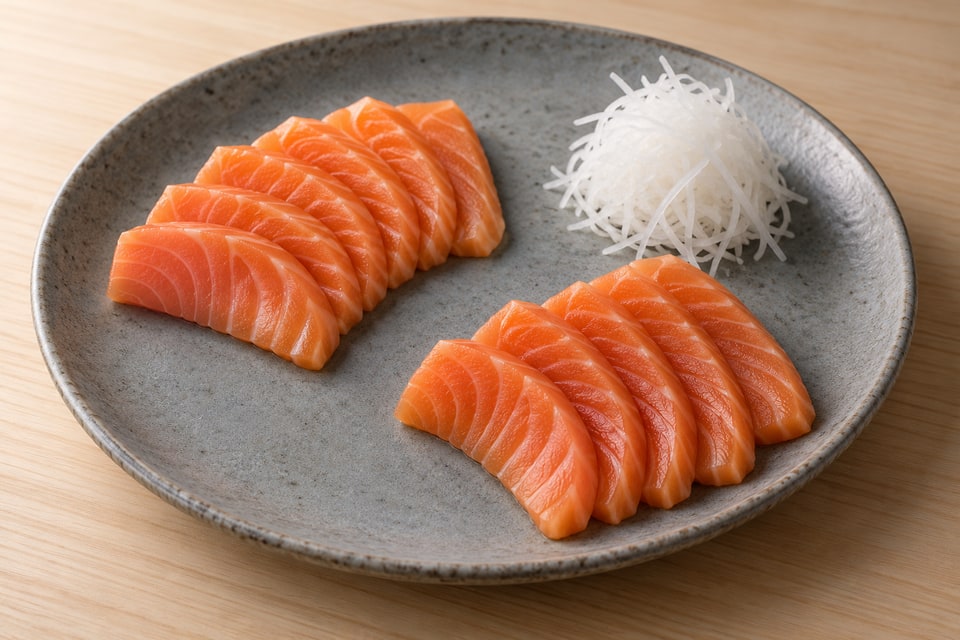
The pull cut is the fundamental technique for slicing raw fish into sashimi or sashimi-style toppings. Position your blade at a 45-degree angle to the cutting board, with the knife's edge facing your body. Place the blade at the top of your fish, then pull the knife toward you while pushing gently downward. The motion should be smooth and single—you pull once from top to bottom in one motion rather than sawing back and forth. This single-motion pull creates a clean surface that exposes the fish's interior beauty and creates a texture that's pleasant to eat. A sawing motion crushes the fiber and creates a torn appearance. The angle of the blade determines the thickness of your slice. A steeper angle (closer to vertical) creates thinner slices; a shallower angle creates thicker slices. For sashimi, aim for about 1/8 to 1/4 inch thickness, which is approximately a 45-degree blade angle. Wipe your blade between each slice with a damp cloth to remove proteins that impede clean cuts.
The Straight Cut (Oshi-Giri) for Rolls
The straight cut is used to slice finished rolls into individual pieces. After rolling and shaping your maki, position the blade perpendicular to the roll (straight, not angled). Slice with a single smooth drawing stroke and light downward pressure—let the blade's edge do the work rather than pressing, chopping, or hacking. The knife should slice through the nori and rice cleanly with minimal compression. Wet your blade frequently (every one or two cuts) because rice sticks to the knife and creates ragged edges. Some chefs dip their blade in water; others use a damp towel. The goal is clean, even pieces where nori is not crushed and rice grains are not smashed. If your rolls are compressing rather than slicing cleanly, your knife is either dull or too dry. Eight pieces is the standard: cut the roll in half, line the two halves up side by side, then make three evenly spaced cuts across both to yield eight pieces. From a standard roll (about 7.5 inches long), each of the eight pieces will be approximately 1 inch wide. This size is considered one piece for serving and presentation purposes.
The Angle Cut (Sogi-Giri) for Nigiri Toppings
The angle cut, sometimes called the rectangle cut or sogi-giri, is used for slicing fish into topping-sized pieces for nigiri. Unlike the pull cut for sashimi, the angle cut lays the blade over at a shallow diagonal to shave off wide, thin slices. Position your blade at a shallow angle—roughly 30 to 45 degrees to the fish—and draw the knife toward you in one smooth stroke, shaving off a wide, thin slice. The shallower the angle, the wider and thinner the slice. This creates a topping that's appropriately sized and shaped for nigiri—typically about 2 by 1 inch and 1/8 inch thick. The fish should be pulled against your claw-grip fingers as you cut, moving incrementally after each slice to control portion size. This cut requires precision because nigiri pieces must be consistent in size. Inconsistency in nigiri topping size affects both the final plating and the eating experience. Practice this cut until you can produce six to eight pieces of remarkably similar dimensions from one piece of fish.
Sharpening Basics: Whetstone Fundamentals
A sharp knife is more important than an expensive knife. Even the best knife becomes useless when dull. At home, a whetstone (sharpening stone) is the most practical sharpening tool. For beginners, a combination stone (1000 grit on one side, 6000 grit on the other) provides both aggressive sharpening and finishing. Whet your knife when it begins to fail to slice cleanly or requires more pressure than it should. Most home cooks need to whet every two to three months with regular use. To whet, place the stone on a damp towel (which prevents slipping) and wet the stone with water. Place your blade on the stone at approximately 15 degrees (for single-bevel Japanese knives) and pull the blade toward you along the stone's length. Repeat this motion 10 to 15 times on the coarse side until you feel a burr (a fine ridge of metal folded over the cutting edge, felt on the side opposite the one you are grinding). Flip to the fine side and repeat until the burr disappears. This process takes ten minutes and restores sharpness dramatically. Stropping (running the blade along a leather surface) maintains the edge between whetstones.
Knife Types: Know Your Purpose
While a single good chef's knife suffices for home sushi, understanding specialized knives helps. A yanagiba is a single-bevel blade specifically designed for slicing raw fish. It's longer (8 to 10 inches) and narrower than a chef's knife, allowing for longer, cleaner strokes. A deba is a heavy-duty knife used for breaking down whole fish and bone work. A usuba is a rectangular blade used for precise vegetable work. A santoku is a Japanese all-purpose knife that combines elements of a chef's knife and yanagiba. A sujihiki is like a yanagiba but slightly heavier and used for slicing cooked items. For the home cook, a yanagiba is a worthwhile upgrade once you've mastered technique, but it's not necessary to start. A sharp 7-inch chef's knife accomplishes every task in the beginner track. Avoid collecting too many knives; three to four well-maintained knives (chef's knife, paring knife, and perhaps a yanagiba) represent a complete home kitchen.
Maintenance, Storage, and Longevity
A sharp knife is useless if it's accidentally damaged. Store your knife on a magnetic strip, in a knife block, or with a blade guard—never loose in a drawer where it bangs against other utensils. Hand wash your knife immediately after use; dishwashers dull and damage knives. Dry it immediately to prevent rust. Never place your knife flat on a countertop where someone might bump it or step on it. When washing, grip the handle only, never the blade, and keep your focus on the task. Avoid using your knife on very hard surfaces like bones (use a cleaver or butcher's knife instead) or frozen surfaces. Microplaning or rough cutting boards damage the edge. These simple practices extend your knife's life from years to decades. A well-maintained knife becomes more pleasant to use over time as you develop the subtle muscle memory of its particular weight, balance, and sharpness. This long relationship with a single tool is one of the deep satisfactions of learning sushi.
Keep these details in mind.
- Proper grip and claw-hand positioning are more important for safety than knife sharpness; technique prevents injuries
- Master the pull cut (hiki-giri) for sashimi, the straight cut (oshi-giri) for rolls, and the angle cut (sogi-giri) for nigiri toppings
- A single sharp chef's knife outperforms a collection of dull specialized knives; sharpness matters more than cost or specialization
- Whet your knife every 2-3 months on a 1000/6000 combination stone until a burr forms, then finish on the fine side
- Store, hand-wash, and dry immediately; proper maintenance extends the life of your knife from years to decades
From reading to cooking.
Salmon Sashimi Platter · Perfect Sushi Rice
Return to the journal ↗